From physical attacks and the killing of prominent journalists to cybercrime cases, censorship and digital restrictions, Pakistan’s media landscape has faced persistent challenges between 2018 and October 2026.
ISLAMABAD — November 1, 2026 | By Editorial Team
Pakistan’s media industry has experienced nearly a decade of serious challenges to press freedom, with journalists facing physical violence, targeted killings, abductions, threats, arrests, criminal proceedings and censorship, according to a comprehensive report by World Watch Alert.
Titled Pakistan: Violence Against Journalists, 2018–2026, the 60-page report examines incidents and developments from 2018 through October 2026, drawing on monitoring by the Pakistan Press Foundation (PPF), Freedom Network, International Federation of Journalists (IFJ), Committee to Protect Journalists (CPJ), Reporters Without Borders (RSF) and the Human Rights Commission of Pakistan (HRCP).
A Troubling Statistical Picture
The report’s year-wise overview presents a concerning picture of violence and violations against journalists.
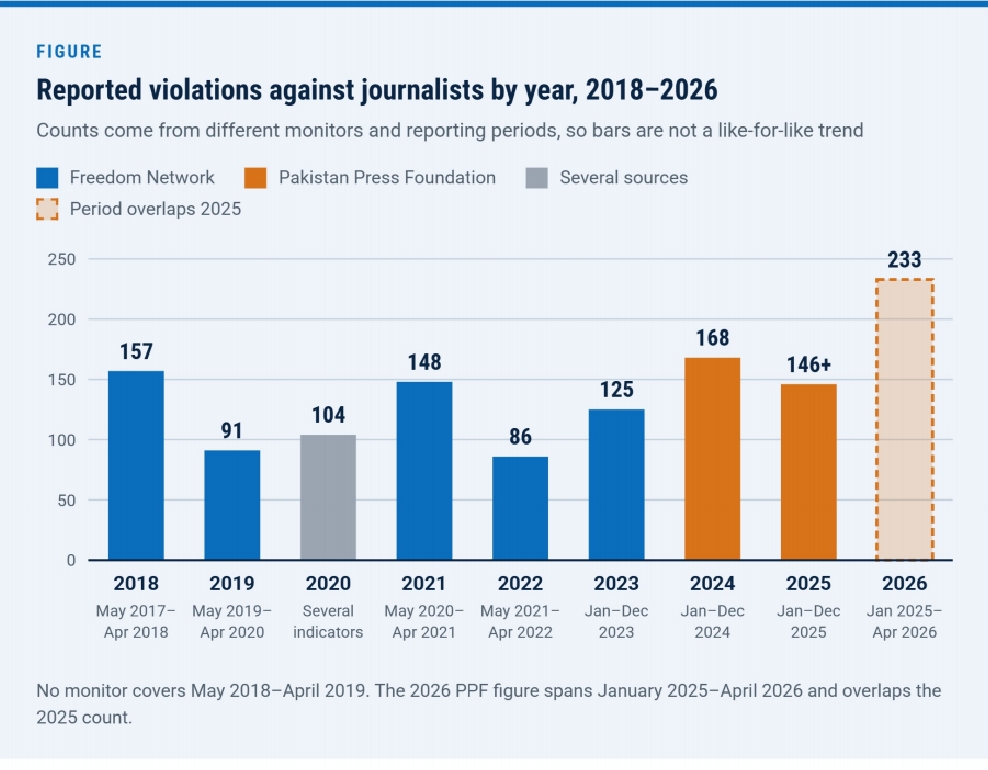
The recorded figures are 157 for 2018, 91 for 2019, 104 for 2020, 148 for 2021, 86 for 2022, 125 for 2023, 168 for 2024, at least 146 for 2025 and 233 for the January 2025–April 2026 monitoring period.
The report emphasises that these numbers are drawn from different monitoring periods and methodologies. They cannot be treated as a single continuous annual dataset or added together to establish a reliable nine-year cumulative total.
Nevertheless, the figures highlight the persistent scale of threats facing media professionals in Pakistan.
2018–2022: Physical Violence and Editorial Pressure
Between 2018 and 2022, journalists faced a combination of physical attacks, alleged abductions, killings, arrests and restrictions on political reporting.
The 2018 election period witnessed reports of intimidation, restrictions on media distribution and pressure on journalists covering political developments.
In 2019, television interviews involving opposition political figures were interrupted, while media organisations reported pressure over coverage of government policies and state institutions.
In 2020, journalist Matiullah Jan was abducted in Islamabad and returned after approximately 12 hours. The arrest of Jang and Geo Group editor-in-chief Mir Shakil-ur-Rahman also generated considerable concern among media organisations.
The situation remained serious in 2021. Journalist Absar Alam was shot near his home in Islamabad, while Asad Ali Toor reported being assaulted by unidentified men. Television anchor Hamid Mir was also suspended by Geo News following his speech at a protest.
In 2022, the killing of investigative journalist Arshad Sharif in Kenya became one of the most prominent cases involving a Pakistani journalist. Other journalists were killed while reporting or working in different parts of Pakistan.
2023: Abductions, Disappearances and Digital Restrictions
The political crisis of May 2023 brought further challenges for journalists covering protests and political developments.
Television anchor Imran Riaz Khan was arrested at Sialkot Airport on 11 May and remained missing from public view for more than four months. He returned home on 25 September. Who held him was not publicly established.
Journalists and media crews also faced reported assaults, harassment and detentions during protests.
Mobile internet services and social-media platforms experienced restrictions following the political unrest.
Freedom Network documented 125 threat cases during calendar year 2023, including two journalist murders, 17 assaults resulting in injuries and 20 legal cases.
2024: A Particularly Dangerous Year
The year 2024 emerged as one of the most concerning periods in the report.
The Pakistan Press Foundation documented at least 168 attacks and censorship-related violations against journalists and media professionals.
These included:
- 76 physical assaults.
- Four abductions.
- Five arrests.
- Twelve detentions.
- Fifteen cases registered against media professionals.
- Eight instances of FIA action.
- Fifteen online harassment incidents.
- Thirty-one censorship-related incidents.
- Nineteen internet, mobile-connectivity and social-media disruptions.
Among the most alarming developments were the killings of Muhammad Siddique Mengal, Nasrullah Gadani, Kamran Dawar and Khalil Jibran.
Journalists were also summoned by the FIA over online content, while freelance journalist Asad Ali Toor was arrested in February.
The blocking of X and the nationwide suspension of mobile-phone services on election day further affected the environment for reporting and access to information.
2025: Legal Proceedings and the PECA Amendment
In 2025, concerns about legal pressure on journalists increased alongside physical violence.
The Prevention of Electronic Crimes (Amendment) Act 2025 introduced Section 26-A, creating criminal penalties for certain intentional dissemination of false or fake information likely to cause fear, panic, disorder or unrest.
Journalists and digital-rights advocates expressed concerns that the law’s broad language could discourage investigative journalism and criticism of public institutions.
PPF documented at least 146 attacks on journalists and media professionals during the year.
Its statistics included 38 physical assaults, eight arrests, 30 registered cases against media professionals and 24 documented legal actions.
The IFJ recorded three journalists killed in Pakistan in 2025: Abdul Latif Baloch, Khawar Hussain and Imtiaz Mir.
The federal Commission for the Protection of Journalists and Media Professionals was established in November 2025, marking an institutional development. However, its effectiveness depends on implementation, resources and independent functioning.
2026: Cybercrime Cases and Continued Threats
The first ten months of 2026 witnessed continued concerns over physical violence, arrests, cybercrime investigations and restrictions affecting journalists.
Freedom Network’s published monthly reports recorded 61 cases between January and September 2026. The report clarifies that this is an arithmetic sum of published monthly figures, not a verified count of unique journalists or a complete national census.
Separately, PPF documented at least 233 incidents of violence, threats, legal action and restrictions between January 2025 and April 2026. This figure overlaps the 2025 reporting period.
Several prominent journalists faced legal proceedings or other forms of pressure.
Asad Ali Toor received an NCCIA notice in September 2026 under Section 26-A of PECA.
Television anchor Iqrar-ul-Hassan was arrested in October in a cybercrime case involving alleged social-media content. The allegations remained before the courts.
Other cases involved journalists Razi Tahir (Editor World Watch Alert), Sohrab Barkat, Muhammad Bilal Ghauri and Khurram Iqbal.
These developments demonstrate the increasing importance of digital rights and legal protections for journalists working across traditional and online media.
Pakistan’s Position in the Global Press Freedom Index
Pakistan’s international press-freedom position also reflects continuing challenges.
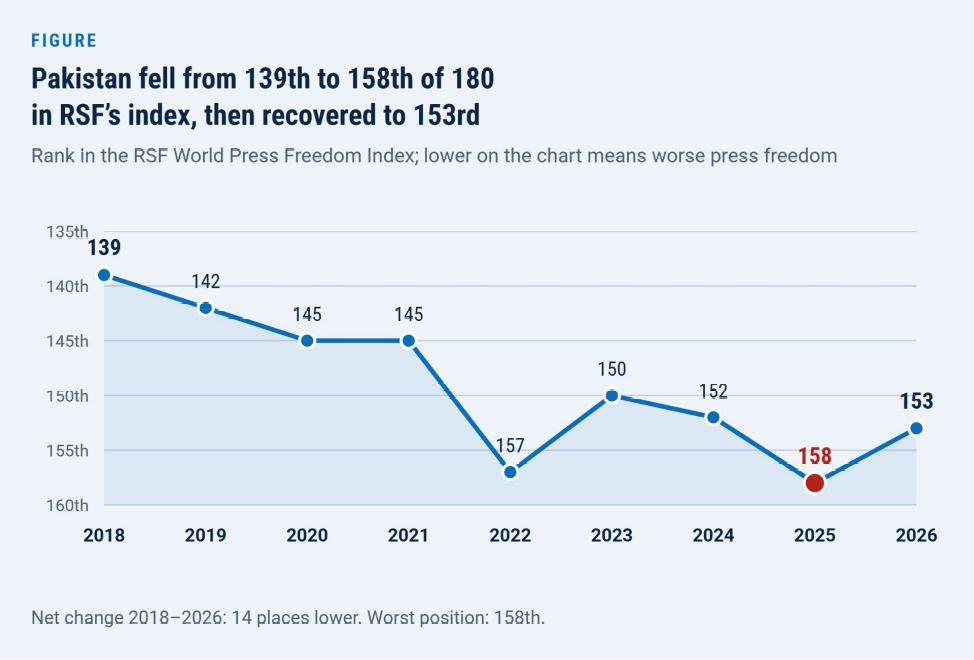
According to the RSF rankings compiled in the report, Pakistan ranked 139th out of 180 countries in 2018.
Its position deteriorated to 157th in 2022, improved to 150th in 2023, fell to 152nd in 2024 and reached 158th in 2025.
In 2026, Pakistan improved to 153rd.
Despite this improvement, its position remained 14 places lower than in 2018.
Accountability Remains a Major Concern
One of the most significant findings concerns the limited accountability for crimes against journalists.
Freedom Network’s 2022 impunity report examined 53 journalist murders recorded between 2012 and 2022 and found convictions in only two cases.
The figures underline the need for effective investigations, prosecution and institutional protection.
The report also highlights the importance of distinguishing between allegations, reported incidents and established judicial findings. Responsibility for individual attacks must be determined through credible investigations and due legal process.
Protecting Journalism Is Essential
The findings of Pakistan: Violence Against Journalists, 2018–2026 demonstrate that threats to journalism extend beyond physical violence.
Censorship, legal pressure, online harassment, internet restrictions, economic insecurity and unresolved attacks all affect the ability of journalists to report independently.
The protection of journalists requires more than statements of support. It requires effective investigations, independent institutions, transparent legal procedures, protection against intimidation and accountability for those responsible.
An independent media is essential for democratic accountability and the public’s right to information.
The report concludes that meaningful press freedom depends on ensuring that journalists can investigate, report and express themselves without fear of violence, unlawful detention or retaliation.