Laying the Foundation for Sustainable Growth
BY: Syed Feroz Ahmed
Houston, Texas
Pakistan’s Federal Budget 2026–27 is primarily a budget of economic stability rather than rapid growth. Its main objective is to protect the macroeconomic gains achieved over the past two years, fulfill commitments under the IMF supported reform programme, and prevent a return to the financial pressures that pushed the country close to an economic crisis in 2022–23.
The budget has been presented at a time when several key economic indicators have improved significantly. Inflation has fallen sharply from the exceptionally high levels seen in 2023, foreign exchange reserves have recovered, the current account has moved into surplus, and investor confidence has strengthened. Exports and workers’ remittances have also continued to grow.
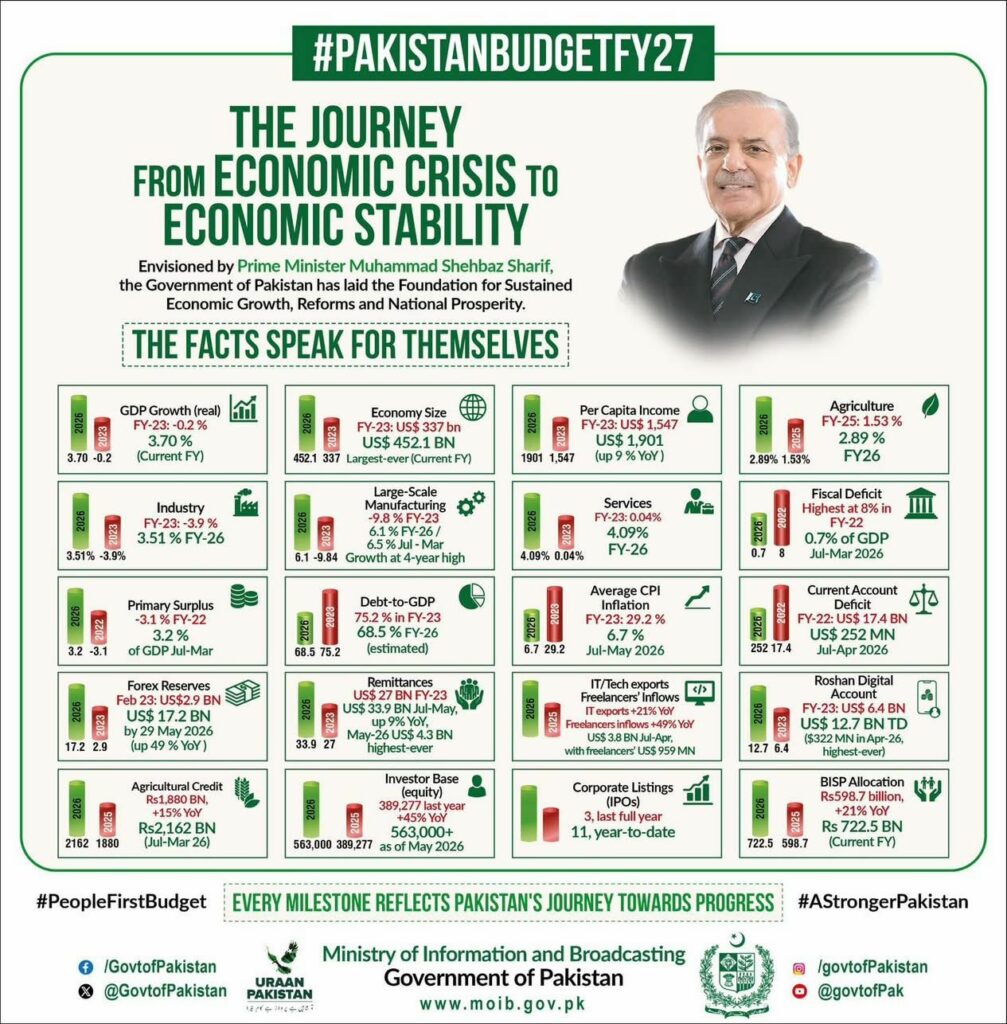
These developments indicate that Pakistan has moved away from immediate crisis conditions and entered a period of relative economic stability.
However, these achievements should not be mistaken for a complete economic recovery. The progress made so far reflects the restoration of macroeconomic stability and renewed confidence among investors, businesses, development partners, and overseas Pakistanis.
The next challenge is to transform this stability into higher investment, stronger exports, increased employment opportunities, and sustainable long term growth.
Any assessment of the Federal Budget 2026–27 must therefore consider both Pakistan’s current economic situation and its broader economic history, which has been characterized by periods of growth, setbacks, and recurring financial challenges. Understanding these realities provides a clearer perspective on the circumstances under which this budget has been prepared. Viewed in this context, the budget appears less as an ambitious growth agenda and more as a strategy to safeguard the hard earned economic stability achieved in recent years.

While public debate and criticism are important components of the democratic process, equal attention should be given to effective implementation. The government, private sector, investors, and citizens all have a role to play in supporting reforms and ensuring that the intended benefits of the budget are fully realized.
Budget Overview
The Government of Pakistan has proposed a federal budget outlay of Rs 18.77 trillion for FY 2026–27, reflecting its commitment to sustaining economic recovery while maintaining fiscal discipline. The Federal Board of Revenue (FBR)has been assigned a tax collection target of Rs 15.26 trillion, underscoring the government’s focus on enhancing revenue mobilization, broadening the tax base, and improving compliance to strengthen fiscal sustainability.
For the upcoming fiscal year, the government has set a GDP growth target of 4.0 percent and an average inflation target of 8.2 percent, aiming to support economic expansion while keeping price pressures under control. The fiscal deficit is projected at approximately 3.6 percent of GDP, reflecting continued efforts toward fiscal consolidation and prudent financial management in line with broader macroeconomic objectives.
On the expenditure side, debt servicing remains the largest component of federal spending, highlighting the ongoing fiscal burden of public debt. Defence expenditure has been allocated Rs 3.0 trillion, while Rs 1.0 trillion has been earmarked for the Public Sector Development Programme (PSDP) to finance infrastructure development, energy initiatives, social sector projects, and other priority investments. These allocations demonstrate the government’s attempt to strike a balance between fiscal responsibility, national security requirements, and development priorities.
Overall, the FY 2026–27 budget is designed to promote economic stability, support sustainable growth, and strengthen the country’s fiscal position amid evolving domestic and global economic challenges.
Key Strengths of the Budget
One of the strongest features of the FY 2026–27 federal budget is its continued emphasis on fiscal discipline and macroeconomic stabilization. Pakistan has historically faced persistent fiscal deficits and rising public debt, and the current budget reflects efforts to improve revenue collection while maintaining expenditure control. With a total outlay of Rs 18.77 trillion and an ambitious FBR tax target of Rs 15.26 trillion, the government aims to strengthen financial stability and improve investor confidence through enhanced domestic resource mobilization.
The budget also includes targeted relief measures and incentives for salaried individuals, exporters, and the business community, aiming to support consumption, strengthen export competitiveness, and encourage private sector activity. These measures are expected to improve overall economic sentiment and provide limited but important support to growth.
Another positive feature is policy continuity, which is essential for sustaining investor confidence, maintaining engagement with international financial institutions, and ensuring predictable economic direction. Alongside this, moderating inflation (projected at 8.2%) and relative macroeconomic stabilization create potential space for easing monetary conditions, which could gradually reduce borrowing costs and support investment activity.
In addition, the budget places continued emphasis on export growth and remittance inflows, which remain critical sources of foreign exchange stability and external account resilience.
Key Challenges
Despite these positive elements, several structural challenges continue to constrain Pakistan’s fiscal and economic outlook. The most significant is the heavy burden of public debt servicing, which remains the largest expenditure component of the budget. With a substantial allocation of around Rs 3.0 trillion for debt servicing-related obligations, a large share of federal resources is consumed before development spending can be prioritized. Together with defence expenditure of Rs 3.0 trillion, these commitments significantly limit fiscal space for education, healthcare, infrastructure, and social development.
Another major challenge is Pakistan’s narrow tax base and low tax compliance, which continues to place a disproportionate burden on salaried individuals and the formal corporate sector. Expanding the tax net remains essential to improving revenue sustainability and reducing structural fiscal pressure on compliant taxpayers.
Although the government has set a GDP growth target of 4.0 percent, achieving and sustaining higher growth remains dependent on deep structural reforms. Pakistan continues to face constraints such as low industrial productivity, limited export diversification, energy sector inefficiencies, subdued investment levels, and governance related bottlenecks. Addressing these challenges will require consistent and long term policy implementation.
Overall Assessment
The Federal Budget 2026–27 should be viewed primarily as a stabilization and consolidation budget, focused on strengthening fiscal discipline, maintaining macroeconomic stability, and preserving gains from recent economic adjustment measures. Its framework of Rs 18.77 trillion in total expenditure, Rs 15.26 trillion revenue target, and 3.6% fiscal deficit reflects a continued effort to restore economic balance and maintain credibility with investors and international financial institutions.
The budget sends a positive signal of policy continuity and fiscal responsibility, which is important for sustaining investor confidence and external financial support. However, it does not introduce major structural breakthroughs that could significantly transform productivity, accelerate long-term growth, or substantially enhance global competitiveness.
Ultimately, while economic stabilization remains a necessary foundation, Pakistan’s long term economic progress will depend on deeper reforms aimed at expanding exports, improving governance, strengthening human capital, and attracting sustained investment to generate broader and more inclusive growth.
Way Forward
The FY 2026–27 budget provides a foundation for stability, but future progress depends on turning stability into growth. Key priorities should include broadening the tax base, improving the energy sector, increasing investment, and promoting exports and industrial growth.

Investment in education, skills, technology, and infrastructure is also essential for long term competitiveness and job creation. At the same time, stronger governance and consistent policies are needed to improve investor confidence and ensure effective implementation of reforms.
In conclusion, the FY 2026–27 budget is a stabilization budget, aimed at strengthening economic foundations. The key challenge ahead is to ensure that this stability leads to sustained and inclusive economic growth.

Author’s Note:
A qualified Economist with Honors and Master’s degrees, researcher, and senior energy sector executive. Formerly associated with world renowned organizations in leadership roles and a prolific writer / analyst on diverse contemporary issues since 2002.