In Washington, D.C., a significant political development has emerged as U.S. Congressman Raja Krishnamoorthi, a senior member involved in national security and intelligence oversight, has issued a strongly worded letter to President Donald J. Trump, warning against any unilateral move to withdraw the United States from North Atlantic Treaty Organization.
The letter, dated April 8, 2026, expresses deep concern over President Trump’s recent remarks indicating that he is “absolutely” considering leaving NATO and suggesting that the alliance is no longer necessary for the United States.
Krishnamoorthi emphasized that such statements risk undermining decades of transatlantic security cooperation established since NATO’s founding in 1949.
According to the Congressman, any unilateral withdrawal from NATO would not only be strategically reckless but also illegal under existing U.S. law.
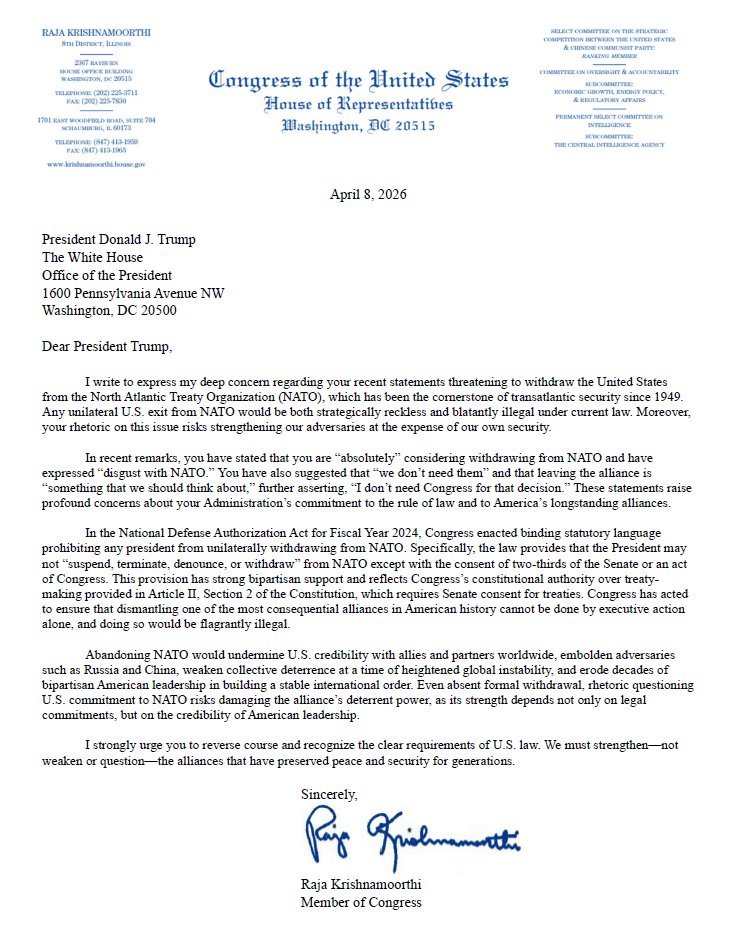
He pointed to provisions in the 2024 National Defense Authorization Act, which prohibit a president from exiting NATO without either a two-thirds majority approval in the Senate or authorization from Congress.
Krishnamoorthi further criticized the rhetoric used by President Trump, including expressions of “disgust” toward NATO, arguing that such language damages U.S. credibility among its allies and weakens the alliance’s deterrence power.
He warned that even signaling doubt about America’s commitment could embolden global rivals.The letter also highlighted broader geopolitical risks, noting that a U.S. withdrawal from NATO could benefit adversarial powers such as Russia and China, while destabilizing the global security order and eroding decades of bipartisan American leadership.
In closing, Krishnamoorthi urged President Trump to reverse course and uphold both U.S. law and longstanding international commitments. He called for strengthening alliances that have preserved global peace and security for generations, rather than weakening them at a time of rising global tensions.
The development comes amid heightened geopolitical uncertainty, with analysts viewing the exchange as a reflection of deepening divisions within U.S. foreign policy circles and a potential signal of major shifts ahead in Washington’s global strategy.