WASHINGTON: US President Donald Trump announced on Thursday that he would postpone strikes on Iran’s energy infrastructure to April 6, 2026, citing ongoing discussions with Tehran, despite the Iranian government denying that any formal peace talks had occurred. The delay comes after Trump had previously threatened to target the Islamic Republic’s energy sites unless it reopened the strategically critical Strait of Hormuz within 48 hours.
Trump took to his Truth Social platform to confirm the extension, writing that “Talks are ongoing and, despite erroneous statements to the contrary by the Fake News Media and others, they are going very well.” He added that the pause on energy plant destruction had been granted at Iran’s request, giving the US additional time before potential strikes.
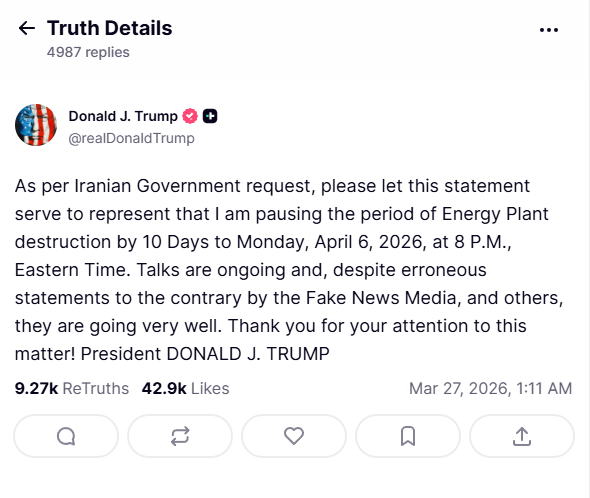
The announcement followed days of mixed military and diplomatic developments. Iran reportedly responded to Washington’s 15-point peace proposal through intermediaries, according to the Tasnim news agency, seeking an end to US-Israeli attacks, reparations for war damages, and recognition of its sovereignty over the Strait of Hormuz. Tehran has also allowed 10 oil tankers to pass through the strait, signaling some willingness to engage in dialogue, even as officials have maintained that indirect exchanges via intermediaries do not constitute formal talks.
Despite the pause, Pentagon sources cited by the Wall Street Journal indicated that the US is considering sending up to 10,000 additional ground troops to the Middle East. These developments contributed to continued market volatility. Oil prices fell more than 1% on Friday, partially reversing the previous day’s surge, amid persistent fears that the conflict could drag on. Since the war began on February 28, Brent crude has risen nearly 50% and West Texas Intermediate (WTI) about 40%.
Equities also suffered across global markets. Tokyo and Seoul, which had been strong performers earlier in the year, recorded significant losses, while Hong Kong, Sydney, Wellington, Taipei, Jakarta, and Manila markets fell sharply. Shanghai and Singapore markets showed fluctuations amid ongoing uncertainty.
Investors remain skeptical of White House messaging, noting that Trump frequently alternates between threats and the prospect of peace. Stephen Innes of SPI Asset Management said, “A ten-day extension sounds like breathing room, but in market terms, it feels more like a trader rolling a losing position forward, hoping the next candle delivers what the last one refused to give. Time has been purchased, not clarity. And the market knows the difference.”
Economic analysts also warned of broader consequences. National Australia Bank’s Ray Attrill highlighted that whether substantive peace talks are occurring remains debatable, with Iran emphasizing that letter exchanges via friendly intermediaries — reportedly including Pakistan — are not formal negotiations. Meanwhile, the World Trade Organization reported the global trading system is facing the “worst disruptions in the past 80 years,” and the World Bank said it was ready to offer immediate financial assistance to emerging markets.
The Organisation for Economic Co-operation and Development (OECD) warned that US inflation could surpass 4% this year due to soaring crude prices, up from its prior forecast of 2.8%. The spike in energy costs has prompted several Federal Reserve officials to signal that interest rates are unlikely to decrease in the near term, heightening concerns about the outlook for the US economy.
Governments worldwide are acting to cushion the economic impact. Spain approved a $5.8 billion package, including steep cuts to energy taxes. Poland announced measures such as reduced fuel taxes and price ceilings, while South Korea unveiled a $17 billion “wartime” supplementary budget and expanded fuel tax reductions to ease the burden on consumers.
The combined effect of ongoing military threats, delayed diplomacy, and economic turbulence continues to unsettle global markets, with analysts emphasizing that both energy and financial systems remain highly sensitive to developments in the US-Iran confrontation.