By: Hasnain Walji, Ph.D.
History flatters itself. It prefers to tell us that nations are born in grand moments, shaped by stirring speeches and collective awakenings. It leans toward inevitability, as if events unfolded because they had no other choice. But history, when examined with less romance and more honesty, turns not on noise, but on clarity.
In March 1940, in Lahore, clarity arrived in the form of Muhammad Ali Jinnah.
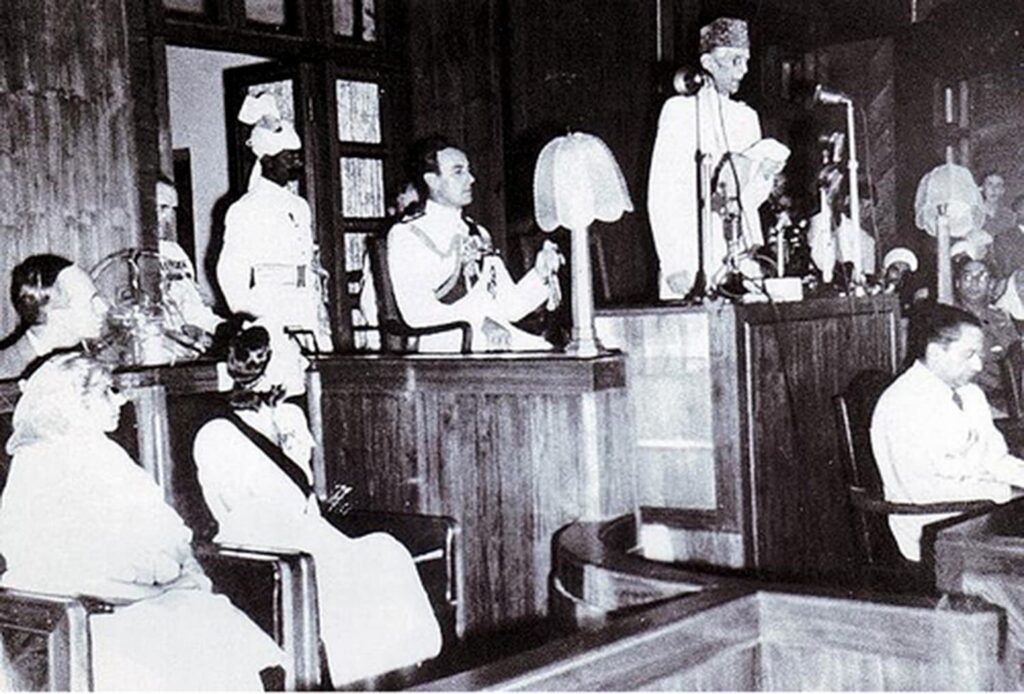
To understand that moment, however, one must begin elsewhere. In a room of negotiation. Civil, composed, and deceptively polite. Across the table sat Lord Louis Mountbatten, representing an empire that had governed India for nearly two centuries and, by habit, believed it still understood it. His argument was familiar: India could remain united with better safeguards, more thoughtful arrangements, and a little more time. Nothing, in his view, was fundamentally broken; it merely required improved management.
Jinnah listened, as he always did, without interruption and without visible impatience. And then he reduced the argument to its essence. The British, he implied, were treating a fundamental reality as if it were an administrative inconvenience. The difference between the two men was not political but conceptual. Mountbatten was attempting to manage a transition. Jinnah was insisting on defining reality. Once that distinction became clear, compromise began to look less like a solution and more like avoidance.
The tragedy of that exchange was not hostility but misunderstanding. As Mirza Ghalib once captured with unsettling precision, “Yā Rab! Woh na samjhe hain, na samjhenge meri baat, de aur dil unko, jo na de mujhko zabān aur.” The problem was not the absence of language but the absence of shared comprehension. Jinnah was not struggling to express himself; he was confronting an audience that did not yet inhabit the same intellectual framework.
By the time we arrive in Lahore in March 1940, we are not witnessing the birth of an idea. We are witnessing the moment it becomes impossible to ignore.
Under a large tent in Minto Park, the annual session of the All-India Muslim League brought together leaders from across the subcontinent. They came from Bengal, Punjab, Sindh, the United Provinces, and the Frontier, each carrying distinct political interests and expectations.
Figures such as A. K. Fazlul Huq, who would move the resolution, and Chaudhry Khaliquzzaman, who would second it, were joined by leaders like Sikandar Hayat Khan and Liaquat Ali Khan, each bringing their own calculations to the gathering. Behind the scenes, Sir Muhammad Zafarullah Khan drafted the resolution with careful, almost cautious language.
The text itself did not shout. It spoke of “independent states” in Muslim-majority regions. The phrasing was deliberately ambiguous, open-ended enough to maintain agreement among diverse interests.
It was a document designed to hold consensus, not to provoke rupture. On its own, it might have remained negotiable, another artifact of political compromise.
What transformed that document into history was not its wording, but its interpretation.
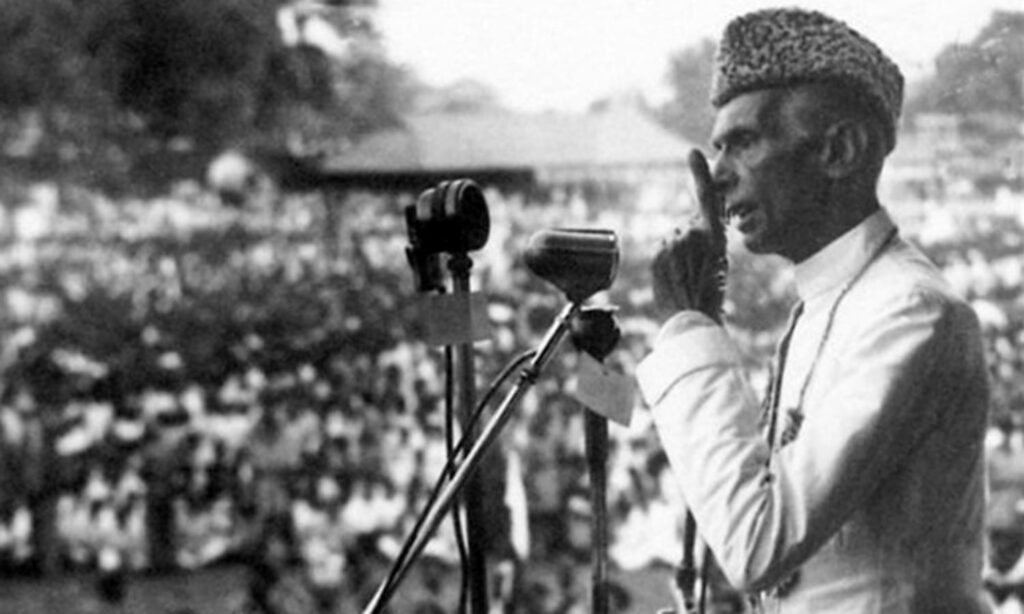
When Jinnah rose to speak, he did not merely present the resolution; he reframed its meaning. He began with a statement that altered the intellectual landscape: “The problem in India is not of an inter-communal character, but manifestly of an international one.” With that, the issue was no longer a dispute within a nation but a negotiation between nations. The frame had shifted, and with it, the logic of every subsequent argument.
He followed with an assertion that anchored the movement: “Muslims are not a minority, as it is commonly understood… Muslims are a nation according to any definition of a nation.” In that moment, a community was repositioned. It was no longer a group seeking protection but a people asserting parity.
This idea did not emerge in isolation. Years earlier, Muhammad Iqbal had articulated its philosophical foundation: “Fard qaem rabte millat se hai, tanha kuch nahi.” The individual exists through the bond of the community. Iqbal defined the millat as a moral and civilizational entity; Jinnah translated that insight into political language, bridging the distance between thought and structure.
Jinnah’s argument did not rely on sentiment. It relied on clarity. He observed that it was difficult to understand why Hindus and Muslims were still being treated as a single nation, and he explained why: “The Hindus and the Muslims belong to two different religious philosophies, social customs, and literatures…” This was not a rejection of coexistence but of imposed uniformity.
The conclusion followed with logical precision: “To yoke together two such nations under a single State… must lead to growing discontent and final destruction.” The inevitability of conflict, in his view, was structural, not emotional.
He then turned to constitutional design, emphasizing that no workable plan could ignore the realities of demography and identity, insisting that Muslim-majority areas must be grouped accordingly.
He reinforced this with a broader historical observation: “The history of the last twelve hundred years has failed to bring them together into one nation.” This was not pessimism but pattern recognition, a reading of history stripped of wishful thinking.
The true significance of Lahore, however, lies beyond its text and arguments. It lies in what it did to the minds of people.
Before Lahore, Muslim politics was cautious. It revolved around safeguards, representation, and negotiation within an existing framework. After Lahore, something shifted. A community began to see itself differently, not as a minority seeking accommodation but as a nation with a claim to self-determination. This shift was psychological as much as political, and once it occurred, a new possibility emerged: sacrifice.
Not abstract sacrifice, but real sacrifice. Homes. Stability. Belonging. And eventually, lives.
Lahore did not create that willingness. It made it conceivable, and then, for many, inevitable.
Jinnah’s genius did not lie simply in demanding a separate homeland. It lay in changing the question. From how do we protect ourselves, to who are we, and ultimately, what are we prepared to sacrifice for that identity. Once a people begins to ask those questions, the trajectory of history changes.
For the diaspora today, the context is different, but the underlying challenge remains. We live in societies defined by opportunity and stability, yet beneath that comfort lies a persistent tension between assimilation and identity, between belonging and distinctiveness.
Jinnah’s insight offers a way through that tension. Coexistence does not require erasure, and integration does not require surrender, but both demand clarity.
A community uncertain of itself cannot negotiate its place with confidence. It either dissolves into its surroundings or reacts defensively to them. Clarity allows for something more balanced: participation without disappearance.
Jinnah did not rely on emotional appeal or dramatic flourish. He thought with precision and spoke with restraint, and in doing so, he altered the course of history. History may celebrate those who provide answers, but it is shaped more profoundly by those who redefine the questions themselves.
In Lahore, in 1940, Jinnah did exactly that. And once the question changed, the answer followed.
About the Author:
Dr Hasnain Walji is a researcher, writer, and educator focused on history, identity, and digital knowledge systems. He is the creator of the Jinnah Portal, a digital initiative dedicated to primary materials and scholarship on Muhammad Ali Jinnah. He serves as Executive Director of the United Global Initiative (UGI) and is Founding Director of the ARK Institute, working at the intersection of education, community development, and technology. With decades of leadership across nonprofit and academic spaces, Walji specializes in translating complex historical narratives into accessible frameworks for contemporary audiences, particularly within diaspora communities.